
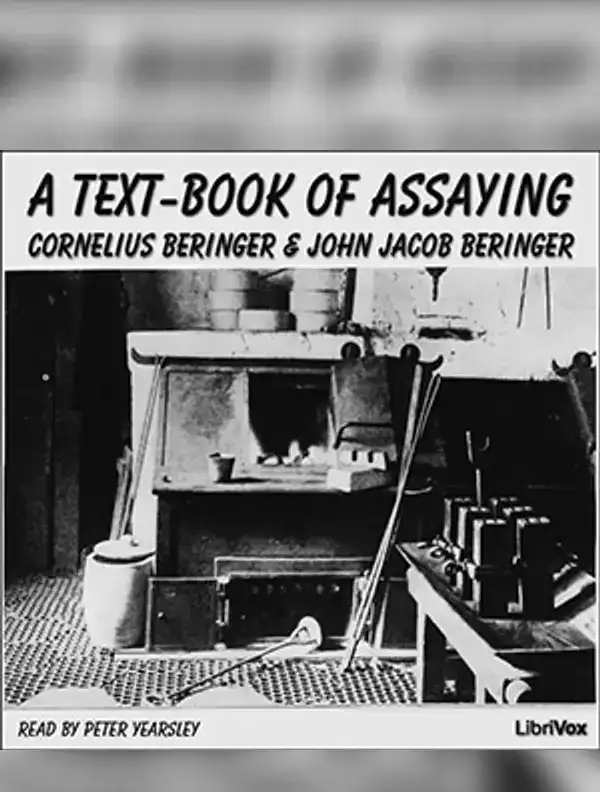
When nineteenth-century mining operations expanded globally, precise chemical evaluation turned raw mineral extraction into a rigorous quantitative science. Cornelius Beringer and John Jacob Beringer created a definitive manual that bridged theoretical laboratory chemistry and practical field testing at the turn of the twentieth century.
Text-book of Assaying, written by Cornelius Beringer and John Jacob Beringer, is a foundational non-fiction technical reference on metallurgical analysis first published in 1889. The work delivers systematic instructions for wet and dry chemical testing of precious, base, and rare ores. It is ideal for historians of science, mining enthusiasts, and metallurgists, though non-technical readers may find its dense laboratory protocols difficult to navigate.
| Metric / Attribute | Details |
|---|---|
| Author(s) | Cornelius Beringer and John Jacob Beringer |
| First Published | 1889 (Featured Edition: 1904) |
| Genre / Sub-genre | Non-Fiction / Metallurgy, Analytical Chemistry, Technical Manual |
| Main Themes | Empirical precision, standardization of chemical assaying, industrial metallurgy, scientific experiment design |
| Target Audience | Metallurgists, historians of chemistry, mining engineers, technical bibliophiles |
| Tone & Style | Instructional, formal yet accessible, empirically rigorous |
Plot Overview & Premise
Text-book of Assaying operates as a comprehensive guide to evaluating the metallic and non-metallic contents of mined mineral samples. Rather than focusing solely on substances of high commercial volume, the authors deliberately expanded their scope to cover lesser-known and rare elements, providing a full survey of analytical chemistry as understood at the turn of the twentieth century.
The manual is structured logically, moving from foundational laboratory concepts to element-specific testing procedures:
- Foundational Principles & Mechanics: Early chapters establish basic assay theory, covering dry gravimetric methods, wet gravimetric procedures, volumetric assays, precise weighing techniques, and reagent preparation.
- Precious Metals & Amalgams: Extensive chapters detail methods for isolating and measuring silver, gold, platinum, mercury, and cyanides.
- Base & Industrial Metals: Comprehensive analytical guides address copper, lead, thallium, bismuth, antimony, iron, nickel, cobalt, zinc, and cadmium.
- Refractory & Rare Elements: Specific sections evaluate tin, tungsten, titanium, manganese, chromium, and alkaline earths.
- Non-Metallic Components: Dedicated breakdowns cover halogens, oxygen, sulfur, sulfates, arsenic, phosphorus, nitrogen, silicon, carbon, and boron.
Throughout each protocol, the Beringer brothers illustrate how subtle variations in heat, reagent concentration, or apparatus setup impact the accuracy of the result, reinforcing the necessity of strict scientific discipline in industrial assaying.
Key Themes & Literary Analysis
The central thesis of the text centers on empirical accuracy as the cornerstone of modern industrial commerce. Before standardized assaying texts gained widespread distribution, mining valuations often suffered from inconsistent local practices or imprecise guesswork. The Beringer brothers sought to democratize analytical precision, providing clear methodologies that could be reliably replicated across regional labs and remote mining outposts.
The prose style is pragmatic, authoritative, and instructional. The authors balance high-level chemical equations with practical troubleshooting tips, highlighting common sources of error in furnace operations or volumetric titration. By illustrating how individual variables alter chemical reactions, the text functions not merely as a recipe book for chemical assays, but as a teaching text on the scientific method itself.
Who Should Read This?
Recommended For:
- Historians of Science & Technology: Readers interested in late-Victorian and Edwardian chemical methodology and industrial history.
- Metallurgists & Geologists: Professionals seeking historical context on how modern assaying standards evolved from nineteenth-century wet chemistry techniques.
- Academic Researchers: Students of mining engineering history looking for primary source documentation on classical quantitative analysis.
Consider Skipping If:
- Casual Non-Fiction Readers: Those looking for popular science narratives or historical storytelling rather than step-by-step technical procedures.
- Modern Assay Technicians: Analysts looking exclusively for contemporary automated instrument protocols rather than classical wet-chemical and fire-assay operations.
Frequently Asked Questions
Is Text-book of Assaying intended for beginners or experts?
The book was written to serve both students and practicing assayers. It begins with fundamental laboratory techniques, balance operations, and reagent formulas before advancing to complex multi-step elemental separations.
Does this work cover precious metals exclusively?
No. While silver, gold, and platinum receive detailed coverage, the manual covers nearly every commercially relevant metal, rare earth element, and non-metallic mineral matrix encountered in mining operations.
Why does this historical manual remain relevant today?
It offers an invaluable historical benchmark showing how classical chemical principles were standardized during the height of the industrial mining era, serving as a primary reference for historians of analytical chemistry.