
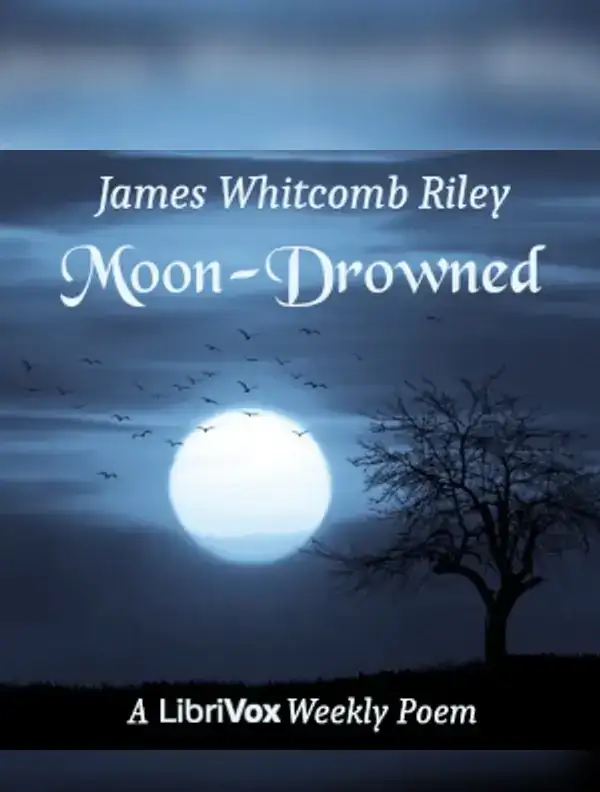
Few poets captured the serene visual landscape of night quite like Indiana’s celebrated writer, James Whitcomb Riley. In “Moon-Drowned,” Riley steps outside his famous rural dialect character studies to paint an atmospheric portrait of a world completely saturated by ethereal midnight light.
Moon-Drowned is a classic lyric poem by American poet James Whitcomb Riley, belonging to late 19th-century nature and romantic verse. The piece focuses on the hypnotic impact of intense lunar light overflowing across the evening landscape, creating a sense of quiet stillness and emotional reflection. This poem is best suited for enthusiasts of classic American poetry, lovers of Victorian-era nature imagery, and spoken-word audio listeners. Readers looking for modern free verse or high-stakes narrative storytelling may find its traditional meter understated.
| Attribute | Details |
|---|---|
| Author | James Whitcomb Riley |
| Genre | Classic American Poetry / Nature Lyric |
| Era / Context | Late 19th / Early 20th Century (Golden Age of Indiana Literature) |
| Core Themes | Luminosity as water, quietude of night, nature’s transformation under moonlight |
| Poetic Form | Rhyming lyric verse with rhythmic meter |
| Target Audience | Fans of historical poetry, spoken-word recitations, and American literature |
Plot Overview & Premise
Unlike long-form storytelling, “Moon-Drowned” operates as a concentrated impressionistic sketch. The work centers on a singular atmospheric condition: nightfall so heavily illuminated by a full moon that the surrounding terrain appears metaphorically submerged beneath a tide of light. Riley uses dense visual phrasing to describe how darkness is displaced by silver hues, turning trees, fields, and air into an underwater-like realm of silence.
The enduring charm of the piece lies in its melodic cadences, making it a favorite choice for public recitation. The poem featured as a LibriVox Weekly Poetry initiative, drawing over twenty distinct vocal interpretations from international volunteer readers. Each performance highlights different nuances in Riley’s rhythm, illustrating how classic verse transforms when spoken aloud across diverse voice types.
Key Themes & Literary Analysis
- Light as a Liquid Medium: The central metaphor turns illumination into a physical fluid. Rather than simply shining, the moon “drowns” the landscape, bathing objects in a dense, quiet radiance that alters human perception.
- Standard English Versatility: While Riley gained fame as the “Hoosier Poet” through regional dialect works like “Little Orphant Annie,” “Moon-Drowned” displays his mastery of polished, traditional English lyrics and formal romantic aesthetic.
- Auditory Cadence and Recitation: The poem relies on balanced rhyme and steady meter, designed specifically for oral reading. The structured pacing creates a tranquil, hypnotic mood that mirrors the stillness of a bright, moonlit night.
Who Should Read This?
Recommended for:
- Readers who appreciate 19th-century American poetry and romantic nature descriptions.
- Spoken-word enthusiasts and audio listeners who enjoy comparing multiple vocal interpretations of short literature.
- Students and scholars exploring the versatile catalog of James Whitcomb Riley beyond his dialect humor.
Not recommended for:
- Readers seeking dramatic narrative plots, character dialogue, or action sequences.
- Fans of contemporary unrhymed free verse who prefer abstract structural experimentation over traditional rhythm.
Frequently Asked Questions
Is “Moon-Drowned” a full-length book or a short poem?
“Moon-Drowned” is a short standalone poem written by James Whitcomb Riley. It is often included in regional poetry anthologies and audio compilations rather than published as an individual book.
Is this poem written in Indiana dialect?
No. While James Whitcomb Riley is famous for his Hoosier dialect poetry, “Moon-Drowned” is composed in standard English using classical lyrical rhythms and formal nature imagery.
Why are there multiple audio versions available for this work?
Because the poem is in the public domain, public audio projects like LibriVox frequently select it for weekly poetry recording challenges, allowing multiple readers to offer their own vocal interpretations of Riley’s meter.