
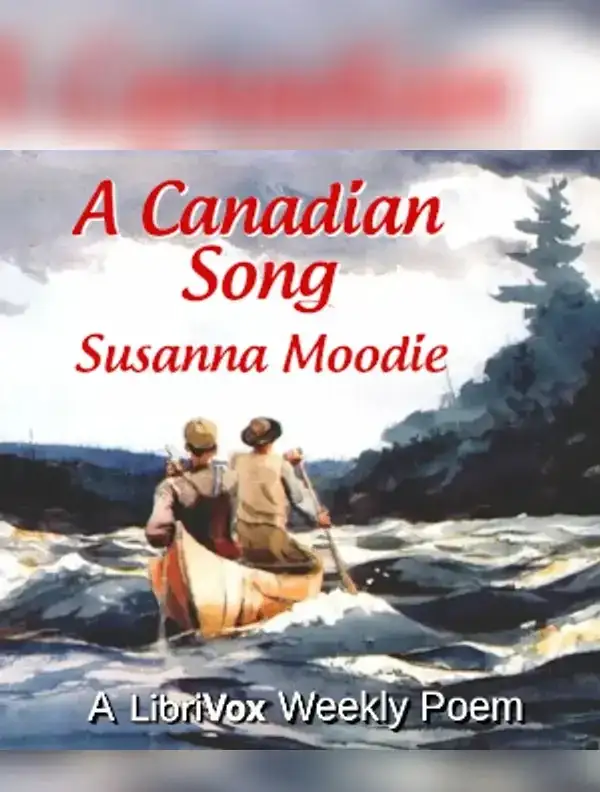
Long before Canada emerged as a distinct global literary voice, nineteenth-century British emigrants struggled to reconcile their European poetic sensibilities with the immense, untamed wilderness of North America. Susanna Moodie’s lyrical work captures this shift, turning away from manicured English gardens to immortalize the rushing rivers and vast lakes of her adopted home.
A Canadian Song by Susanna Moodie is a piece of nineteenth-century colonial pastoral poetry that celebrates the untamed beauty and vital spirit of Canada’s waterways. Written from the perspective of an early settler reflecting on her environment, the poem balances Romantic nature appreciation with a growing pride in the rugged landscape. This work is best suited for readers of classic poetry, scholars of early Canadian literature, and history enthusiasts interested in colonial settler perspectives. Readers seeking modern free-verse structures or action-driven narratives may find its traditional Victorian rhythm somewhat formal.
| Metadata Field | Details |
|---|---|
| Author | Susanna Moodie |
| Publication Era | 19th Century (Colonial Canadian Era) |
| Genre | Pastoral Poetry / Early Canadian Literature |
| Main Themes | Reverence for nature, settler identity, waterways as lifelines, North American wilderness |
| Narrative Perspective | First-person Lyrical Speaker |
| Target Audience | Poetry lovers, historical literature students, fans of Canadian history |
Poem Overview & Historical Context
Susanna Moodie (1803–1885) remains one of early Canada’s most significant literary figures. Having emigrated from England to Upper Canada in 1832 alongside her husband, Moodie documented the harsh realities and quiet wonders of pioneer existence. While she is widely known for her prose memoir Roughing It in the Bush, her poetic works offer a more idealized, emotionally resonant reflection on the landscape.
In A Canadian Song, Moodie turns her focus specifically to the magnificent lakes and rivers that served as the highways of nineteenth-century Canada. Rather than portraying the wilderness as a hostile enemy to be conquered, the verse frames the rushing waters as majestic, invigorating elements that define the character of the country. The poem uses structured stanzas and musical meter to transform the rugged forest terrain into a place of sublime artistic inspiration.
Key Themes & Literary Analysis
- Waterways as the Pulse of the Land: In nineteenth-century Canada, rivers and lakes were essential for travel, trade, and survival. Moodie elevates these functional geography features into symbolic arterial networks that pump energy and beauty throughout the wilderness.
- Romanticism Transplanted to the Frontier: Moodie applies traditional English Romantic conventions—similar to the styles of William Wordsworth and Samuel Taylor Coleridge—to the Canadian landscape. By applying elevated poetic diction to Canadian forests and streams, she legitimizes the wilderness as a subject worthy of fine art.
- The Evolution of Settler Identity: The poem reflects an important psychological transition experienced by early immigrants: moving from homesickness for Britain toward an active affection and emotional investment in the Canadian soil.
Who Should Read This?
Recommended for:
- Students of Colonial Literature: Anyone researching early North American settlement, Canadian cultural history, or 19th-century pioneer writing.
- Classic Poetry Enthusiasts: Readers who appreciate formal rhyme schemes, rhythmic musicality, and nature-focused verse.
- Audiobook Listeners: Public-domain poetry enthusiasts who enjoy comparing multi-voice readings, such as those produced by community volunteer projects.
Who Might Want to Skip:
- Readers looking for contemporary stylistic techniques, modern prose poetry, or complex storytelling plots.
Frequently Asked Questions
What is the core subject of A Canadian Song?
The poem focuses on the splendor and vitality of Canada’s natural waterways. It uses lyrical verse to celebrate the beauty, freedom, and scale of the wilderness, presenting rivers and lakes as defining symbols of the Canadian landscape.
How does this poem reflect Susanna Moodie’s broader work?
While Moodie’s famous memoirs often highlight the severe struggles and labor of pioneer life, her poetry provides a softer, highly aestheticized view of nature. It demonstrates her deep emotional connection to the landscape despite the hardships she faced as a settler.
Is this poem available in public domain audio format?
Yes, because the work was published in the 19th century, it is in the public domain. It is frequently recorded by open-source platforms like LibriVox, where readers can hear multiple voice interpretations of the same text.