
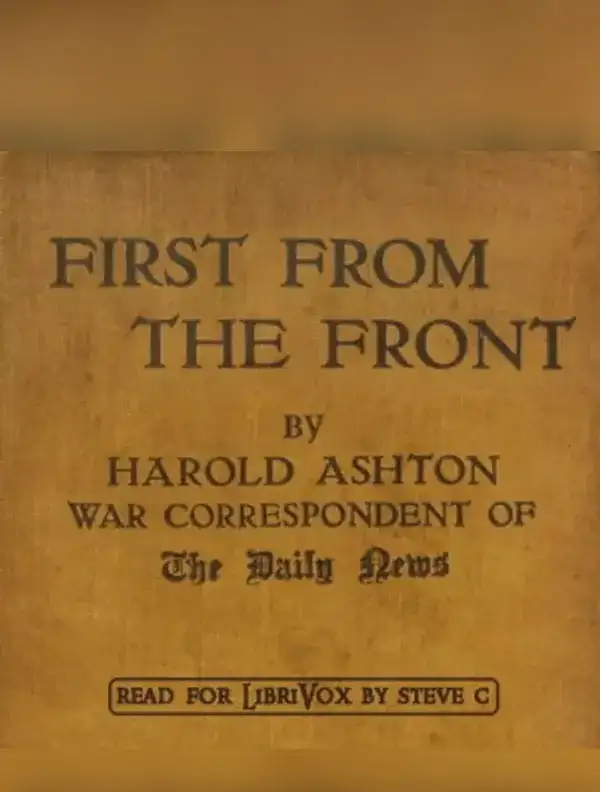
When Europe descended into war in the late summer of 1914, Harold Ashton grabbed his reporter’s notebook and rushed toward the emerging front lines before the conflict could harden into static trench warfare. His dispatch-style narrative offers an immediate, unfiltered look at the confusion and humanity defining the opening moves of the Great War.
First From The Front by Harold Ashton is a non-fiction war journalism memoir capturing the initial months of World War I. Reporting for The Daily News, Ashton travels through hazardous North Sea shipping lanes and across the disrupted countryside of Northern France. The narrative focuses on the direct human cost and surreal ironies of military mobilization. This book is ideal for readers seeking primary historical perspectives and human-interest accounts of early WWI, though readers looking for comprehensive top-level military strategy might prefer formal campaign histories.
| Author | Harold Ashton |
|---|---|
| Publication Era | 1914 (Early World War I) |
| Genre | Non-Fiction / War Reporting / Historical Memoir |
| Main Themes | Human resilience, contrast of comedy and tragedy, civilian displacement, early war mobilization |
| Target Audience | Military history buffs, fans of historical journalism, WWI researchers |
| Narrative POV | First-Person Observer (Journalistic Memoir) |
Plot Overview & Premise
First From The Front records Harold Ashton’s rapid deployment as a war correspondent for London’s The Daily News at the start of World War I in August 1914. His journey begins not on a military transport, but aboard a Danish supply ship running the gauntlet across a North Sea newly littered with naval mines and hostile patrols. This maritime venture introduces the reader to the unsung naval workers and mine-sweepers maintaining supply lines amid sudden peril.
Upon reaching continental Europe, Ashton maneuvers through Northern France, following the rapid movements of British and French forces during the Allied retreat toward Paris and the subsequent counter-offensives. His journey takes him through key locales such as Beauvais, Senlis, and Lassigny. Rather than remaining in official press quarters, Ashton embedding himself in the chaos of the roads, encountering a cross-section of wartime society: French infantrymen, foreign legionnaires, fleeing refugees, exhausted grave-diggers, and captured soldiers. Through twenty-two tight chapters, Ashton provides a episodic, ground-level chronicle of a continent transforming overnight into an active battleground.
Key Themes & Literary Analysis
Ashton’s writing stands apart from official military dispatches due to its explicit focus on human interest and tone balance. His literary approach relies on several key thematic pillars:
- The Coexistence of Tragedy and Comedy: As Ashton notes in his introduction, navigating extreme horror requires recognizing moments of absurd levity. He explicitly mentions bringing the “rattle of the bells” into dark corridors, using observational humor as an essential defense mechanism against total despair.
- Human-Interest Firsthand Reporting: Rather than analyzing broad troop movements or high-command decisions, Ashton prioritizes the experiences of ordinary individuals. He captures the quiet dignity of mine-sweepers, the plight of displaced families on “piteous pilgrimages,” and the individual stories of front-line combatants.
- The Suddenness of Total War: The text captures the jarring transition of peaceful rural towns in France into contested zones of destruction (such as the sack of Senlis). Ashton documents a world caught off guard by modern industrial warfare before the Western Front solidified into static trenches.
Who Should Read This?
Recommended For:
- First World War Enthusiasts: Readers interested in authentic, primary-source accounts written in real-time during 1914.
- Journalism History Buffs: Anyone fascinated by early 20th-century war reporting and field correspondence.
- General Non-Fiction Readers: Those who prefer personal human stories over dry, tactical breakdowns of troop movements.
Who Might Skip It:
- Readers seeking an exhaustive, objective strategic overview of World War I military campaigns.
- Those expecting a continuous fictional plot with central character arcs.
Frequently Asked Questions
Is First From The Front a fictional novel or a true historical account?
It is a true, non-fiction historical account. Harold Ashton was an actual war correspondent for The Daily News, and the book collects his real-time observations and dispatches from the front lines in 1914.
Does this book cover the entire duration of World War I?
No. The book covers a specific window of a few weeks at the very beginning of the war in late 1914, capturing the initial naval movements in the North Sea and the early mobile phase of conflict in Northern France.
What style of writing can readers expect from Harold Ashton?
Ashton writes in an engaging, observational early-20th-century journalistic style. He balances stark depictions of destruction with personal anecdotes, empathetic character sketches, and moments of dry lightheartedness.