
Late Elizabethan readers opening John Donne’s satirical verses encountered something radically different from the smooth, mellifluous lyrics of his contemporaries: jagged meters, aggressive wordplay, and a harsh, provocative cynicism designed to mirror the grotesque realities of London society.
John Donne’s Satires is a collection of early modern satirical poems and mock-epic verse by Renaissance poet John Donne, falling within early modern social satire and metaphysical poetry. The works critique legal corruption, religious factionalism, courtly hypocrisy, and human moral degeneration through intentionally jarring meters and dense linguistic puzzles. This collection is essential for scholars of Renaissance literature and metaphysical poetry, though readers seeking harmonious, traditional verse may find its deliberately abrasive style challenging.
| Author | John Donne |
|---|---|
| Era / Period | Late Elizabethan / Early Jacobean (c. 1590s–1601) |
| Genre | Metaphysical Poetry / Verse Satire / Mock-Epic |
| Core Themes | Social & Legal Corruption, Religious Inquiry, Transmigration of Souls, Stylistic Rebellion |
| Tone & Meter | Abrasive, intentionally irregular (asprezza), sharp, sardonically witty |
| Target Audience | Students of Renaissance literature, poetry analysts, and enthusiasts of metaphysical verse |
Plot Overview & Premise
John Donne’s satirical works—comprising five core satires, the satirical verse Upon Thomas Coryat’s Crudities, and the ambitious mock-epic fragment Metempsychosis (or The Progress of the Soul)—offer a scathing diagnostic of late 16th-century English culture. Rather than offering gentle moral guidance, Donne uses his verse to expose the absurdities and greed lurking beneath London’s legal, political, and spiritual institutions.
The individual satires address specific facets of Elizabethan society:
- Satire 1 & 4: The speaker navigates the streets of London and the royal court, encountering foolish fops, empty-headed fashion hounds, and intrusive gossips who embody shallow urban vanity.
- Satire 2 & 5: Focuses on systemic corruption within the legal profession, attacking predatory lawyers, dishonest officers, and extortionist land-monopolists who prey upon the helpless.
- Satire 3: Widely regarded as the intellectual heart of the collection, this poem examines the chaotic state of Christian religion, urging the reader to seek true faith courageously rather than submitting blindly to the authority of Rome, Geneva, or Canterbury.
- Upon Thomas Coryat’s Crudities: A witty, mock-heroic tribute to the famous eccentric travel writer, mocking the inflation of personal vanity in literary culture.
- Metempsychosis: An ambitious, unfinished mock-epic tracing the transmigration of a single corrupt soul based on Pythagorean doctrine. Beginning as the forbidden fruit in the Garden of Eden, the soul migrates through a series of plants and animals—including a mandrake, a sparrow, a fish, a wolf, and a mouse—demonstrating how moral evil dilates and adapts across creation.
Key Themes & Literary Analysis
1. Asprezza and Deliberate Metrical Violence
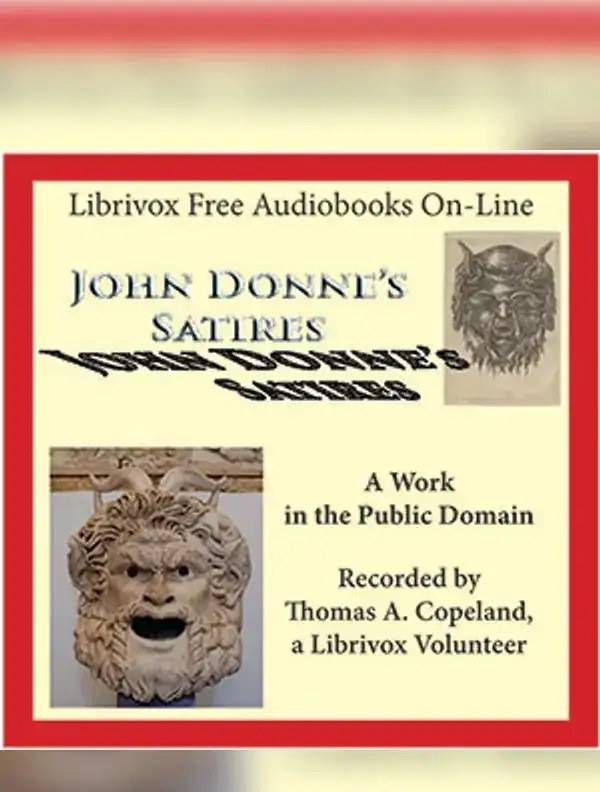
In the Renaissance tradition, satire was conceptually tied to the figure of the Greek satyr—a wild, goat-legged creature of rough manners and harsh speech. Donne deliberately adopts an abrasive poetic style known as asprezza. Rather than failing to construct proper poetic meter, Donne intentionally disrupts the rhythm, using uneven stresses, forced rhymes, and harsh syntax to keep the reader off-balance. By keeping the underlying metrical beat barely audible, the verse creates a feeling of stumbling through a chaotic world, matching the moral disorder of his subjects.
2. Complex Wordplay and Acoustic Double Entendres
Donne relies heavily on semantic shifting and phonetic games, using identical or similar syllables in tight proximity to reveal hidden ironies. Phrases such as “while bellows pant below” rely on shifting accentuation to create distinct meanings within two adjacent words. In Metempsychosis, where a single soul transforms through multiple physical hosts, Donne matches shape-shifting characters with shape-shifting grammar—manipulating adjectives, verbs, and possessives to reflect the fluid nature of identity.
3. The Mechanics of Moral Degeneration
In classical Pythagorean philosophy, the transmigration of souls could lead toward eventual purification. Donne turns this concept upside down in Metempsychosis. The soul does not ascend toward divine light; instead, it undergoes a process of moral expansion and degradation. Moving from the fatal fruit of knowledge through creatures driven entirely by appetite and cunning, the soul demonstrates humanity’s vast capacity for corruption. Donne presents evil not as a sudden collapse, but as an unfolding potential that adapts to every environment it inhabits.
Who Should Read This?
Recommended For:
- Literary Historians & Scholars: Anyone analyzing early modern English satire, Renaissance social critiques, or the evolution of metaphysical poetry.
- Fans of Unconventional Verse: Readers who appreciate dark humor, complex puns, and poetic structures that break traditional formal constraints.
- Theology & Philosophy Students: Those interested in historical debates surrounding religious truth and early modern philosophical satire.
Who Might Want to Skip It:
- Casual Poetry Readers: Those expecting smooth, melodic rhythms or romantic lyricism will find Donne’s intentional metrical roughness difficult to navigate.
- Readers Seeking Narrative Closure: Because Metempsychosis remains an unfinished fragment, those expecting a resolved epic story arc may feel unfulfilled.
Frequently Asked Questions
Are John Donne’s Satires easy to read for modern audiences?
They can be challenging due to Donne’s deliberate use of archaic syntax, dense early modern references, and intentionally rough meter (asprezza). Utilizing an annotated edition helps clarify the historical and legal vocabulary.
What is the meaning of Metempsychosis in Donne’s work?
Metempsychosis refers to the Pythagorean concept of the transmigration of souls after death. Donne uses this idea satirically to trace how an evil soul shifts through various animals and plants, showcasing the persistent decay of moral virtue.
Why is Satire 3 considered the most famous of the collection?
Satire 3 stands out because it shifts from socio-legal mockery to a profound philosophical inquiry into religious devotion. It challenges individuals to actively seek spiritual truth on a steep, cragged mountain rather than passively accepting state-enforced doctrine.