
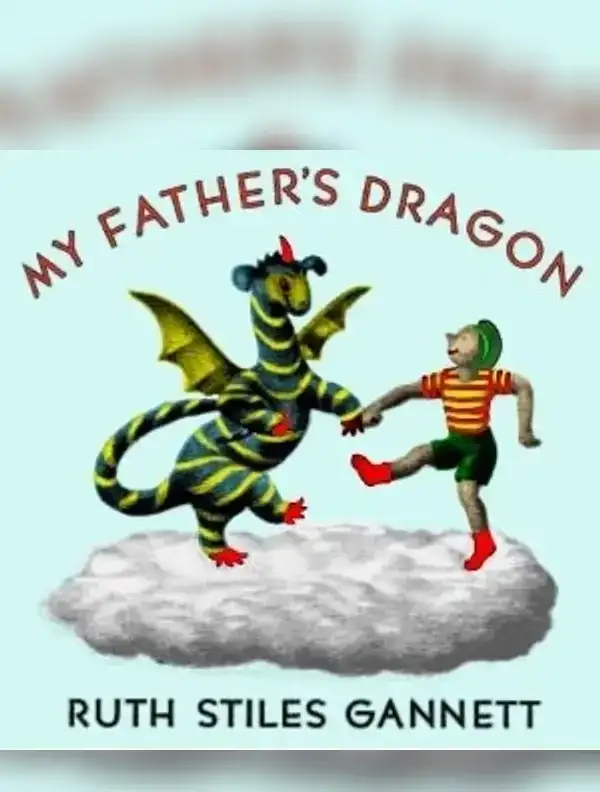
Few children’s stories manage to blend absurd logic and practical problem-solving as effortlessly as Ruth Stiles Gannett’s 1948 classic. By framing a grand rescue mission through the eyes of a young child recounting his father’s childhood exploits, the narrative delivers an unforgettable adventure rooted in cleverness rather than violence.
My Father’s Dragon by Ruth Stiles Gannett is a classic children’s adventure chapter book centering on young Elmer Elevator, who journeys to Wild Island to free a captive baby dragon. Armed only with ordinary household items, Elmer outwits hostile wild animals through sheer ingenuity. This book is best for early readers aged 6 to 9 and parents seeking bedtime read-alouds; mature readers looking for epic fantasy combat or deep character arcs may want to skip it.
| Author | Ruth Stiles Gannett |
|---|---|
| Publication Year | 1948 |
| Genre | Children’s Fantasy / Early Chapter Book |
| Narrative POV | First-person framed narrative (Child detailing his father’s childhood) |
| Main Themes | Resourcefulness over force, empathy for creatures, childhood autonomy |
| Target Audience | Ages 6–9, early independent readers, family read-alouds |
Plot Overview & Premise
The story begins when the narrator’s father, Elmer Elevator, meets an alley cat who reveals a secret: a baby flying dragon has been captured on the remote, jungle-covered Wild Island. The native animals force the young dragon to act as a ferry across a wide river, tying him up and treating him harshly. Moved by compassion, Elmer decides to run away from home to execute a daring rescue mission.
Guided by advice from the cat, Elmer packs a knapsack full of seemingly random items: chewing gum, pink ribbons, rubber bands, hairbrushes, a toothbrush, magnifying glasses, and a jackknife. He sneaks onto a ship bound for the island and begins his expedition through the treacherous jungle.
As Elmer advances toward the river where the dragon is bound, he encounters a series of dangerous wild animals threatening to eat or capture him. Instead of fighting, Elmer uses his knapsack items to exploit each animal’s specific quirk or vanity:
- Tigers: Handed chewing gum, which confuses and delights them enough to let Elmer pass.
- Rhinoceros: Given a toothbrush and paste to clean his dull, dirty tusk.
- Lion: Given a comb, hairbrush, and pink ribbons to style his tangled mane.
- Gorilla & Monkeys: Distracted with magnifying glasses to search for fleas on each other.
In his final hurdle, Elmer uses pink ribbons tied to the tails of hungry crocodiles, lining them up across the river to create a temporary bridge. He crosses safely, cuts the dragon’s ropes with his jackknife, and flies away into the sky, successfully freeing his new friend.
Key Themes & Literary Analysis
Brain Over Brawn: The core ethos of the story lies in non-violent conflict resolution. Elmer never carries a weapon or relies on physical strength. Instead, he treats obstacles as puzzles, relying on observation, preparation, and an understanding of animal nature to disarm potential threats.
Childhood Autonomy and Competence: Gannett treats Elmer as a fully capable individual. Despite his youth, he plans an overseas expedition, manages his own supplies, and navigates danger without adult intervention. This empowers young readers by celebrating self-reliance and creative thinking.
Whimsical Framing and Tone: The narrative framing—a child casually describing “my father” when he was a boy—gives the story a cozy, timeless quality. The matter-of-fact tone used to describe absurd situations (such as lions obsessed with hair care) reinforces a distinct style of classic mid-century children’s literature.
Who Should Read This?
Recommended For:
- Children transitioning from picture books to their first illustrated chapter books.
- Parents and educators seeking engaging, gentle bedtime read-alouds with short, episodic chapters.
- Readers who appreciate classic, non-violent adventure stories centered on smart problem-solving.
Skip If:
- You are looking for realistic fiction or complex fantasy magic systems.
- You prefer fast-paced, high-stakes action scenes over gentle, humorous subversion.
Frequently Asked Questions
Is My Father’s Dragon part of a series?
Yes, it is the first installment in a trilogy. It is followed by Elmer and the Dragon and The Dragons of Blueland, which continue the ongoing adventures of Elmer and his rescued dragon friend.
What reading level is this book appropriate for?
The book is typically targeted at children ages 6 to 9 (grades 1 to 4). Its simple vocabulary, short chapters, and frequent illustrations make it ideal for emerging independent readers or as a family read-aloud book.
What unique method does Elmer use to deal with the wild animals?
Elmer uses ordinary items packed in his knapsack—such as chewing gum, hairbrushes, toothbrushes, and magnifying glasses—to distract the animals by appealing to their vanity, curiosity, or desire for comfort.