
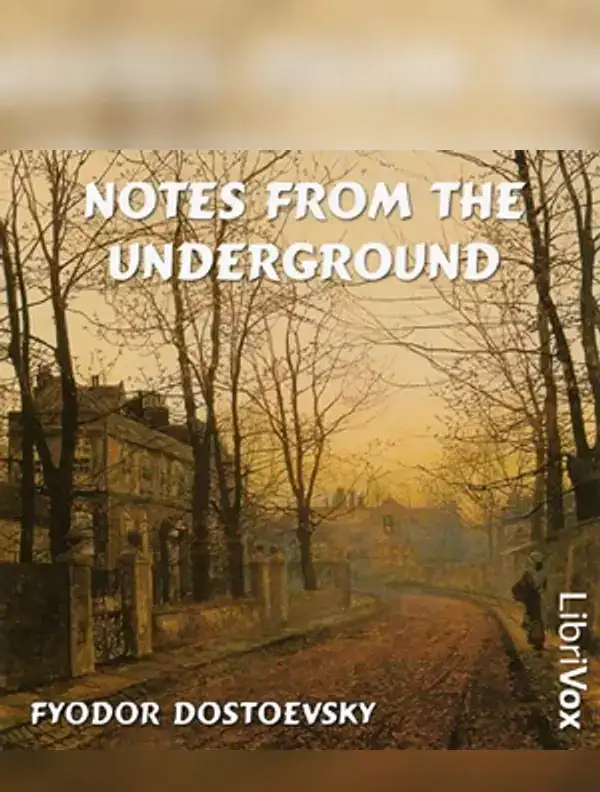
Long before existentialism emerged as a formal school of thought, Fyodor Dostoyevsky constructed an unsparing critique of human irrationality through the voice of an anonymous, bitterly self-aware retired civil servant living in Saint Petersburg. Notes from the Underground by Fyodor Dostoyevsky is a foundational novella of modern philosophical fiction that centers on a spiteful unnamed narrator waging an ideological war against 19th-century rational egoism and utopian determinism. This complex psychological study suits readers of classic literature, continental philosophy, and dark character studies, though it may alienate those searching for fast-paced plotting or conventional moral heroes.
| Metadata Field | Details |
|---|---|
| Author | Fyodor Dostoyevsky |
| Publication Era | 1864 (19th-Century Imperial Russia) |
| Genre / Sub-genre | Philosophical Fiction / Existentialist Novella / Psychological Realism |
| Narrative Perspective | First-person limited (Unreliable Narrator) |
| Key Themes | Free Will vs. Determinism, Rational Egoism, Isolation, Psychological Self-Sabotage |
| Target Audience | Scholars of Russian literature, philosophy enthusiasts, and readers drawn to complex anti-heroes |
Plot Overview & Premise
The novella is divided into two distinct structural halves: an intense philosophical monologue followed by a reflective narrative of past personal failures.
Part 1: “Underground” consists of a feverish manifesto written by the forty-year-old protagonist, often referred to as the Underground Man. Writing from his damp, isolated Petersburg apartment, he addresses an imaginary panel of hostile readers. He argues aggressively against the contemporary belief—popularized by Russian radicals and Western rationalists—that human behavior can be reduced to mathematical formulas and logical self-interest. To prove that human autonomy relies on the freedom to choose even self-destructive actions, he glorifies his own toothaches, spiteful impulses, and intentional social failures, declaring that man will destroy his own well-being simply to prove he possesses free agency.
Part 2: “Apropos of the Wet Snow” shifts to a retrospective narrative detailing specific incidents from the narrator’s youth sixteen years prior. These vignettes illustrate how his philosophical isolation manifests in real-world interactions. He recalls forcing his way into a dinner party hosted by former schoolmates who despise him, resulting in an evening of bitter humiliation. Later that night, he encounters Liza, a young woman forced into prostitution. After delivering a patronizing lecture on her bleak future to assert his intellectual superiority, he invites her to his apartment. When she actually visits, expecting genuine human connection, he experiences profound shame over his poverty and emotional inadequacy, ultimately insulting her and driving her away in a fit of cruel self-defense.
Key Themes & Literary Analysis
Dostoyevsky’s novella operates as a sharp critique of 19th-century scientific determinism and political idealism, particularly responding to Nikolai Chernyshevsky’s utopian novel What Is to Be Done?.
- The Fallacy of Rational Egoism: The central intellectual target of the work is the assumption that educating people on their true self-interest will eliminate crime, malice, and irrationality. Dostoyevsky asserts through the Underground Man that human beings frequently act against their own self-interest out of a fundamental desire to maintain personal autonomy, even if that autonomy leads to suffering.
- The Symbol of the Crystal Palace: The “Crystal Palace”—a modern structure of glass and iron representing technological progress and perfect social order—is rejected by the narrator. He argues that a perfectly engineered society leaves no room for personal volition or individual desire, turning human existence into a mechanical routine.
- Hyper-Consciousness and Paralysis: The narrator’s extreme intellectual self-awareness prevents him from taking meaningful action. Because he analyzes every motive down to its base impulses, he finds himself trapped in constant inaction, unable to respect himself or others.
- Pioneering Modernist Style: The fragmented, contradictory nature of the narration broke away from classic Victorian and Tsarist narrative traditions. Dostoyevsky introduced a form of internal monologue and psychological realism that heavily influenced later literary figures such as Franz Kafka, Jean-Paul Sartre, and Friedrich Nietzsche.
Who Should Read This?
This novella is an essential text for understanding modern literature, though its tone and structure demand specific reader expectations.
Recommended For:
- Readers looking for foundational works in existentialism and moral philosophy.
- Fans of complex, flawed, and intentionally unlikable protagonists.
- Students and scholars of classic 19th-century Russian literature.
May Not Be Suitable For:
- Readers seeking a traditional narrative arc with clear resolution.
- Those who prefer optimistic themes or relatable, sympathetic characters.
Frequently Asked Questions
Is Notes from the Underground a standalone story or part of a series?
Notes from the Underground is a standalone novella. However, it serves as a critical thematic foundation for Dostoyevsky’s major later works, including Crime and Punishment and The Brothers Karamazov.
Why doesn’t the main character have a name?
The narrator remains unnamed to emphasize his status as a universal archetype of modern social alienation and psychological paralysis, earning him the classic literary moniker of the “Underground Man.”
What does “the underground” mean in the context of the book?
The “underground” represents both physical isolation from society and a psychological state of withdrawal, where an individual rejects societal norms, rational consensus, and conventional progress to retreat into internal cynicism.