
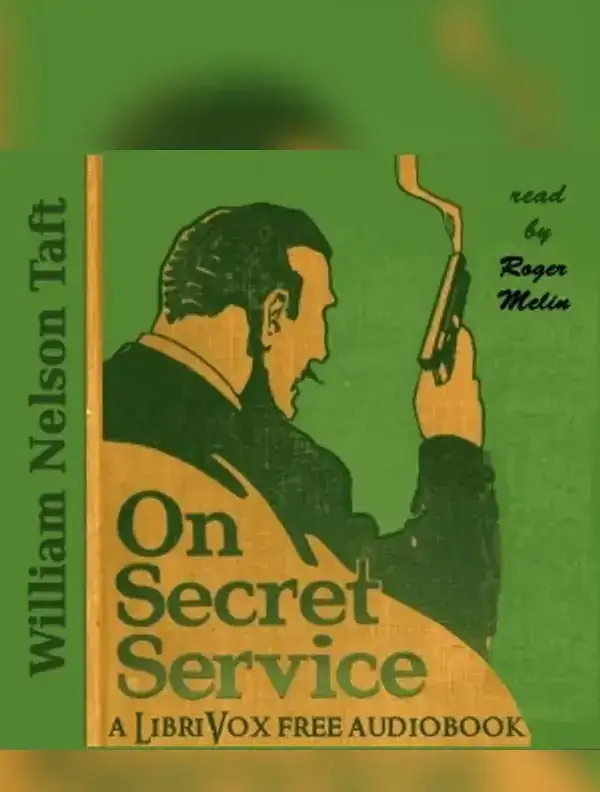
Long before fictional spies dominated popular culture, real federal agents waged a quiet war against counterfeiters, smugglers, and saboteurs across a rapidly modernizing America. William Nelson Taft’s On Secret Service brings this high-stakes world to life through twenty-four dramatized short stories drawn directly from official government records.
*On Secret Service* by William Nelson Taft is a classic collection of detective and true-crime mystery fiction based on authentic U.S. Secret Service cases from the late 19th and early 20th centuries. The book explores federal investigations ranging from coin minting frauds and silk smuggling rings to international codes and illicit wiretapping. This work is ideal for historical mystery enthusiasts and procedural fans, though readers looking for a continuous, novel-length plot line may find its short, episodic format less cohesive.
| Author | William Nelson Taft |
|---|---|
| Original Publication Era | 1921 (Early 20th Century) |
| Genre / Sub-genre | Detective Mystery / Dramatized True Crime / Crime Anthology |
| Main Themes | Federal Law Enforcement, Counterfeiting & Smuggling, Early Forensic Investigation, Cryptography |
| Target Audience | Fans of vintage mysteries, true-crime history buffs, procedural detective fiction readers |
| Narrative Perspective | Third-person episodic narrative |
Plot Overview & Premise
Originally established in 1865 to suppress post-Civil War counterfeiting, the U.S. Secret Service gradually expanded its scope to tackle complex financial crimes, international smuggling, and federal security threats. In On Secret Service, author William Nelson Taft dramatizes twenty-four distinct cases solved by government operatives, blending narrative tension with verified investigative facts.
The anthology spans a broad range of criminal schemes and federal responses:
- Financial Crimes & Counterfeiting: Tales like “The Mint Mystery” and “A Million-Dollar Quarter” focus on illicit currency operations, inside thefts, and intricate coin-forging rings.
- Smuggling & International Intrigue: Chapters such as “Phyllis Dodge – Smuggler Extraordinary,” “Thirty Thousand Yards of Silk,” and “Wah Lee and the Flower of Heaven” examine high-value contraband networks, foreign trade loopholes, and border operations.
- Codebreaking & Communications: In “The Double Code,” “The Clue in the Classified Column,” and “The Girl at the Switchboard,” operatives utilize early wiretapping, cryptography, and print media analysis to outwit cunning syndicates.
- Undercover Sleuthing: Entries like “Five Inches of Death” and “The Trail of the White Mice” feature agents going undercover into dangerous environments to secure tangible physical evidence.
Every chapter operates as a standalone case file, illustrating how patience, logical deduction, and emerging technical tools allowed federal operatives to triumph over elusive lawbreakers.
Key Themes & Literary Analysis
1. Early Procedural Sleuthing and Forensics
Unlike contemporary private detective fiction that relies on eccentric geniuses or luck, Taft emphasizes systematic institutional methodology. Agents analyze physical evidence on library shelves, trace paper stock, intercept communications, and crack double-entry ciphers. The focus remains on methodical investigative legwork and institutional collaboration.
2. Technology and Modernization in Crime
Set during an era of technological acceleration, the stories showcase how both criminals and law enforcement adapted to new tools. Switchboards, taxicabs, telegraph ciphers, and high-speed transit created novel opportunities for crime while simultaneously providing federal investigators with new digital and physical footprints to follow.
3. Realism versus Dramatization
Taft balances authentic agency case files with the pacing of serialized crime fiction. While character dialogue and dramatic beats are reconstructed for storytelling impact, the core mechanics of the crimes—such as revenue tax evasion, bootleg distilling, and custom house fraud—remain accurate to historical precedents.
Who Should Read This?
Recommended For:
- Readers interested in early 20th-century American history and the origin of federal law enforcement agencies.
- Fans of procedural detective shorts, classic mystery anthologies, and authentic crime-solving mechanics.
- Librarians, researchers, and general readers seeking well-crafted, vintage pulp-era mystery writing.
Who Might Want to Skip:
- Readers who prefer a single continuous narrative arc with long-term character development.
- Those expecting modern modern-style explosive espionage action rather than methodical procedural investigation.
Frequently Asked Questions
Is On Secret Service a novel or a short story collection?
It is an anthology of twenty-four standalone short stories, each chronicling a separate federal case solved by Secret Service operatives.
Are the stories in the book completely true?
The cases are based on genuine U.S. Secret Service records and authentic criminal investigations, though dialogue and dramatic scene staging were dramatized by author William Nelson Taft for narrative entertainment.
Does the book follow one primary recurring detective?
No, the collection highlights various operatives across different regional branches and specialized assignments, focusing on the agency as a collective unit rather than a single heroic protagonist.