
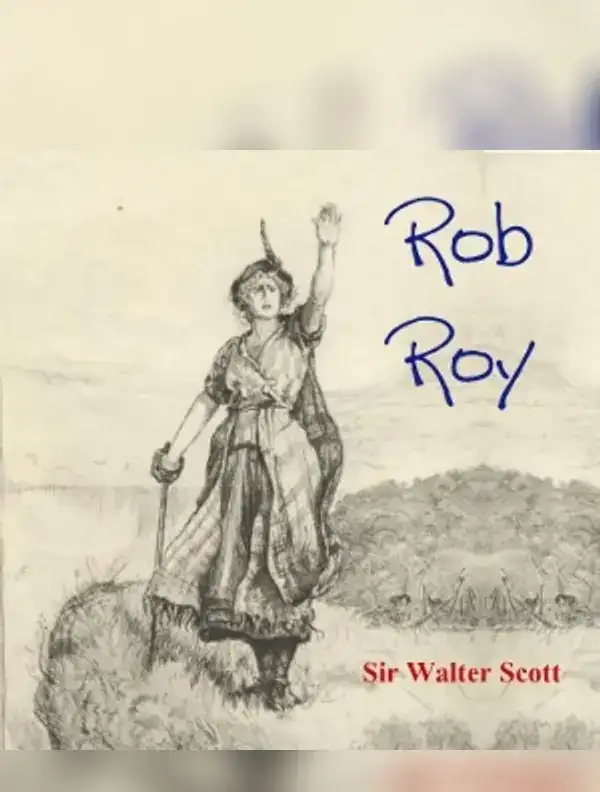
When Frank Osbaldistone rejects his father’s London mercantile empire to pursue poetry, his defiance ignites a dangerous sequence of political intrigues stretching across the 18th-century Anglo-Scottish border. Sir Walter Scott’s historical novel Rob Roy follows Frank’s journey into the Scottish Highlands to recover stolen financial assets essential to saving his family from ruin, placing him in the orbit of the enigmatic Highland outlaw Rob Roy MacGregor. Set against the backdrop of the 1715 Jacobite Rising, this novel contrasts commercial modernity with feudal tradition. It is best suited for fans of classic 19th-century literature and Scottish history, while readers looking for rapid pacing or simple hero narratives may struggle with its dense prose and regional dialect.
| Author | Sir Walter Scott |
|---|---|
| Publication Year | 1817 |
| Genre | Historical Fiction / Adventure Novel |
| Narrative POV | First-person retrospective (Frank Osbaldistone) |
| Main Themes | Commerce vs. Feudalism, Cultural Identity, Romanticism vs. Pragmatism, Political Treachery |
| Target Audience | Classic literature readers, historical fiction enthusiasts, and scholars of Scottish culture |
Plot Overview & Premise
The narrative opens with young Frank Osbaldistone returning to London after studying in France. Refusing to join his father’s prosperous trade firm due to his poetic ambitions, Frank is banished to Osbaldistone Hall, his uncle’s estate in Northumberland. There, he meets his boorish cousins and his cunning, ambitious cousin Rashleigh, as well as the independent and captivating Diana Vernon. Frank soon realizes that Rashleigh harbors sinister motives, conspiring to sabotage the family business and support the clandestine Jacobite movement aimed at restoring the Stuart monarchy.
When Rashleigh flees to Scotland with vital financial notes that threaten Frank’s father with bankruptcy, Frank travels north to recover them. Guided by the pragmatic Glasgow magistrate Bailie Nicol Jarvie and supported behind the scenes by the mysterious Mr. Campbell—who reveals himself as the legendary Highland outlaw Rob Roy MacGregor—Frank enters the dangerous terrain of the Scottish Highlands.
As political tensions escalate toward open rebellion, Frank finds himself caught between British government troops and fierce Highland clans. Rob Roy’s wife, Helen MacGregor, demonstrates ruthless defiance against royal soldiers, illustrating the deep hatred bred by English enforcement. Through tactical cunning, dangerous skirmishes, and crucial assistance from both Rob Roy and Diana Vernon, Frank retrieves the stolen documents, thwarts Rashleigh’s treacherous schemes, and secures his family’s legacy.
Key Themes & Literary Analysis
The Collision of Modernity and Feudalism
Scott structures the novel around the sharp contrast between the emerging capitalist economy of London and Glasgow and the declining feudal clan structure of the Scottish Highlands. Bailie Nicol Jarvie represents the new age of commerce, rule of law, and economic development, whereas Rob Roy embodies an older code of honor, martial strength, and tribal loyalty. Scott does not present either world as purely superior; instead, he documents the inevitable historical transition from ancient tradition to modern commercial stability.
Demystifying the Romantic Outlaw
Unlike stereotypical noble bandits, Scott’s portrayal of Rob Roy MacGregor is rooted in social and political reality. Rob Roy is a complex, pragmatic figure driven into outlawry by corrupt landlords and unfair economic pressures rather than pure chivalric romanticism. He operates as a cattle drover, extortionist, and hero depending on the situation, reflecting the actual historical pressures felt by Highland clans in the early 18th century.
Narrative Distance and Regional Realism
Told as a first-person recollection by an elderly Frank, the story balances youthful romantic idealism with mature reflection. Scott’s extensive use of authentic Scots dialect—particularly through characters like Jarvie and Andrew Fairservice—gives the novel an authentic voice, anchoring the dramatic plot in genuine cultural and linguistic detail.
Who Should Read This?
Recommended For:
- Historical Fiction Enthusiasts: Readers interested in early 18th-century British politics, the Jacobite uprisings, and Scottish history.
- Classic Literature Lovers: Anyone who appreciates intricate 19th-century prose, complex plotting, and moral ambiguity.
- Character-Driven Narrative Fans: Readers looking for strong, memorable supporting characters like Diana Vernon and Bailie Nicol Jarvie.
Who Might Want to Skip:
- Fast-Paced Action Readers: The novel takes time to establish its plot, devoting significant early chapters to family squabbles and philosophical debates.
- Readers Unfamiliar with Dialect: The heavy use of written phonetics and regional Scots dialogue requires patience to digest.
Frequently Asked Questions
Is Rob Roy the main protagonist of the novel?
No, Rob Roy MacGregor is not the narrator or main character. The protagonist is Frank Osbaldistone, an Englishman whose journey drives the plot. Rob Roy functions as a powerful secondary catalyst who assists Frank throughout his adventure.
What historical event forms the backdrop of the story?
The novel takes place in 1715, during the first Jacobite Rising, a political movement aimed at overthrowing King George I and restoring the exiled Stuart dynasty to the British throne.
Is Rob Roy part of Sir Walter Scott’s Waverley Novels?
Yes, Rob Roy belongs to Scott’s celebrated Waverley series, a collection of historical novels that examined Scottish history, social change, and national identity during the late 18th and early 19th centuries.