
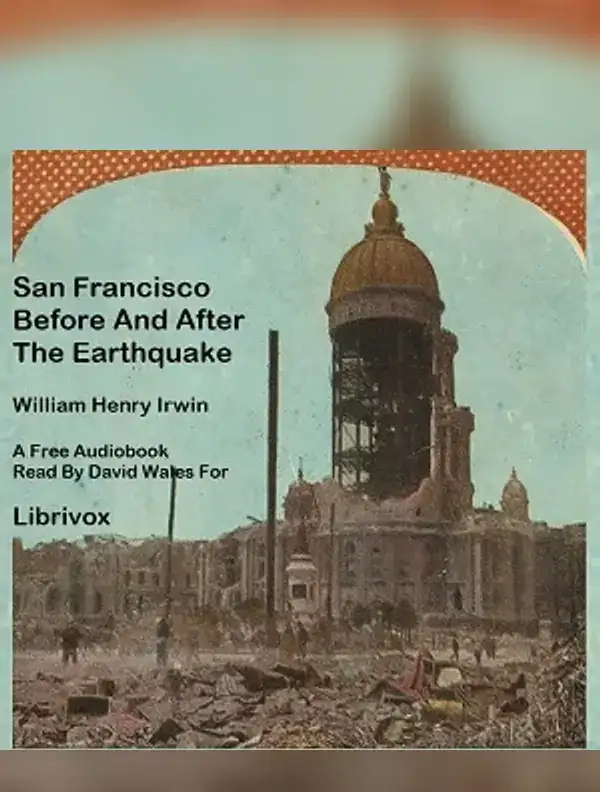
When disaster strikes a beloved metropolis, the grief of an exiled native often produces the most poignant literary eulogies. William Henry Irwin’s written tribute stands as an immediate, raw, and strikingly vivid chronicle of a community erased overnight and reborn through sheer human determination.
San Francisco Before And After The Earthquake aggregates Will Irwin’s celebrated journalistic works, “The City That Was” (1906) and “The City That Is” (1910). Combining elegiac urban portraiture with observational reportage, this non-fiction volume captures the cultural essence of pre-quake San Francisco alongside its rapid post-disaster resurrection. It is ideal for historians, urban culture enthusiasts, and lovers of classic American prose, while readers seeking a traditional fictional narrative may prefer to pass.
| Metadata Field | Details |
|---|---|
| Author | William Henry Irwin (Will Irwin) |
| Original Publication Dates | 1906 (“The City That Was”) & 1910 (“The City That Is”) |
| Genre | Journalism / Historical Essay / Urban Memoir |
| Main Themes | Cultural Memory, Collective Grief, Urban Resilience, Civic Identity |
| Target Audience | American history enthusiasts, San Francisco locals, journalism historians |
| Narrative Perspective | First-person journalistic observer and reminiscence |
Plot Overview & Premise
On April 18, 1906, a catastrophic earthquake followed by an unquenchable fire decimated San Francisco, California. Thousands of miles away in New York, former San Franciscan Will Irwin received news of his former home’s destruction while working as a reporter for The Sun. Overwhelmed by grief and vivid memories, Irwin sat down on April 21 to write an affectionate tribute to the city he knew was gone forever. Titled “The City That Was,” his long-form essay bypassed cold statistics to instead paint an intimate portrait of San Francisco’s bohemian atmosphere, vibrant Chinatown, waterfront saloons, unique geography, and eccentric local characters.
Four years after the tragedy, Irwin returned to the West Coast to witness the city’s progress firsthand. Amazed by the dramatic physical recovery and unwavering spirit of its population, he authored a follow-up piece for The San Francisco Call entitled “The City That Is.” Together, these two texts form a complete arc: a memorial to a lost golden age followed by an celebration of urban rebirth.
Key Themes & Literary Analysis
- Memory as Preservation: Written while ashes were still hot, “The City That Was” uses granular, sensory memory to preserve a physical landscape that no longer existed, illustrating how literature can rescue culture from physical annihilation.
- Indomitable Civic Identity: The paired essays contrast the romanticized nostalgia of the pre-quake era with the practical grit of the rebuilding years, suggesting that a city’s true soul resides in its people rather than its architecture.
- Evolution of On-Demand Journalism: Irwin’s urgent, evocative prose style represents an early precursor to literary journalism, demonstrating how news writing can transcend immediate reporting to become permanent historical art.
Who Should Read This?
- Recommended For: Fans of early 20th-century history, readers interested in California heritage, lovers of urban history, and students of classic American journalism.
- Who Might Skip: Readers looking for a dramatic fictional plotline, character-driven novels, or a technical, scientific analysis of tectonic activity.
Frequently Asked Questions
Is this work a fiction novel or a historical document?
This work is a collection of non-fiction historical journalism. It consists of two long-form newspaper essays written by journalist Will Irwin immediately following the 1906 earthquake and four years later during the reconstruction period.
Why did “The City That Was” become so famous?
Irwin wrote the piece in a single marathon session while news of the city’s destruction was still breaking. Its emotional depth, vivid cultural detail, and prose elevated it from standard news reporting to an instant literary eulogy for old San Francisco.
How long is this work?
It is a short read. The combined essays function as a brief, focused narrative that can easily be finished in one sitting, making it an accessible piece of primary source historical literature.