
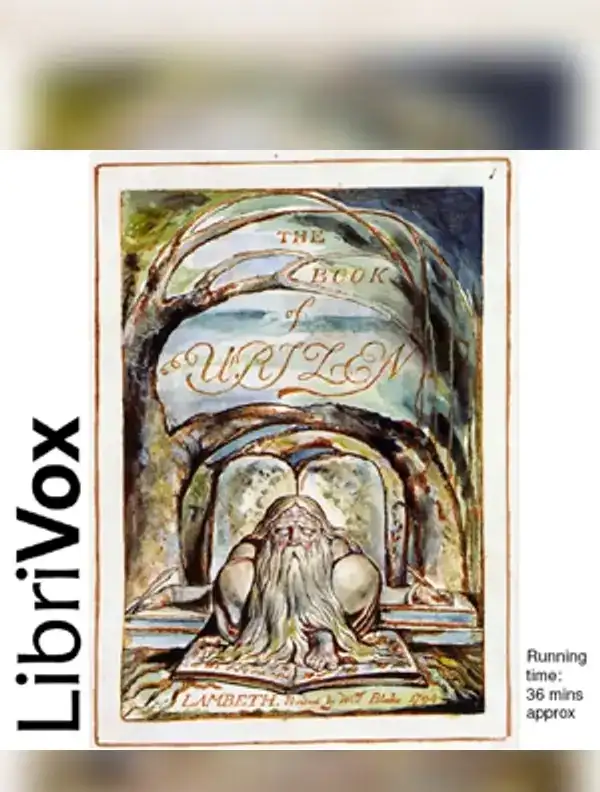
William Blake’s radical mythologies offer a searing critique of eighteenth-century rationalism, recasting cosmic creation not as a divine gift, but as a tragic act of fragmentation and authoritarian control.
The First Book of Urizen by William Blake is an 18th-century prophetic poem and dark mythic epic that parodies the biblical Book of Genesis and John Milton’s Paradise Lost. The central narrative details how Urizen, an embodiment of cold, isolated reason, breaks away from eternity to impose strict, dogmatic laws, forcing the creative force Los to construct a physical realm to bind him. This work is ideal for enthusiasts of Romantic poetry, visionary art, and political philosophy; readers looking for conventional plot structures or straightforward narrative prose may find its dense symbolic framework challenging.
| Attribute | Details |
|---|---|
| Author | William Blake |
| Original Publication Era | 1794 (Romantic Period) |
| Genre / Sub-genre | Prophetic Literature / Mythic Epic / Visionary Poetry |
| Main Themes | The Tyranny of Pure Reason, Cosmic Fragmentation, Religious Dogma, Rebellion vs. Law |
| Target Audience | Scholars of Romanticism, poetry analytical readers, classic literature enthusiasts |
| Narrative POV | Third-person Omniscient / Mythic Bardic Voice |
Plot Overview & Premise
The story opens in the primordial expanse, where the abstract entity Urizen—whose name evokes both “your reason” and the Greek “horizon”—severs himself from the council of the Eternals. Driven by a desire for absolute certainty and unyielding order, Urizen establishes a solitary domain governed by strict moral and physical laws. His withdrawal destabilizes the eternal harmony, causing panic among the other immortal beings.
To contain Urizen’s expanding vacuum of non-entity, the Eternals appoint Los, the eternal prophet representing human imagination and craftsmanship. In a painful, agonizing labor spanning seven immense ages, Los binds the terrifying form of Urizen into a mortal, physical body complete with bones, blood vessels, and sensory organs. The trauma of this process divides Los himself, giving rise to Enitharmon, the first mortal female and the embodiment of pity.
From the union of Los and Enitharmon comes Orc, a child born as the violent, fiery spirit of revolution. Bound to a mountain peak out of jealousy and fear, Orc’s passionate existence awakens Urizen from his stupor. Urizen begins to explore his creation, only to react with horror as he realizes no living creature can uphold his impossible, rigid laws. His sorrow gives rise to four sons representing the ancient classical elements: Thiriel (Air), Utha (Water), Grodna (Earth), and Fuzon (Fire). As Urizen wanders his fallen realm, his weeping spreads the “Net of Religion,” an enveloping web of spiritual delusion that shrinks human perception, reducing once-immortal consciousness into weak, dogmatic mortal existence.
Key Themes & Literary Analysis
Blake utilizes a uniquely constructed pantheon to critique the philosophical, religious, and political structures of his era. Rather than treating reason as a unifier, Blake identifies hyper-rationalism detached from emotional empathy as a destructive, fracturing force.
- The Peril of Isolated Rationality: Urizen represents the dark side of Enlightenment philosophy. When intellect operates without imagination or passion, it constructs prisons of bureaucracy, legalism, and oppressive moral codes.
- Inversion of Genesis: Blake strips traditional creation of its sanctity. Physical birth and the formation of the material world are presented as cruel limitations placed upon limitless cosmic consciousness. Creation is not an act of grace, but a catastrophic fall into physical constraint.
- The Perpetual Cycle of Tyranny and Rebellion: The tragic dynamic between Urizen (law), Los (imagination), and Orc (revolution) illustrates how legalistic oppression inevitably births explosive revolt, which in turn risks spiraling into fresh cycles of conflict.
Who Should Read This?
Recommended For:
- Students of Romantic Poetry: Essential reading for anyone analyzing Blake’s illuminated printing techniques, private mythologies, and anti-establishment commentary.
- Fans of Dark Fantasy and Cosmic Mythologies: Readers who appreciate complex world-building, divine rivalries, and sweeping symbolic narratives will find rich material here.
- Philosophical Literature Enthusiasts: Anyone fascinated by allegorical explorations of human consciousness, authority, and religion.
Who Might Want to Skip:
- Casual Readers Seeking Standard Fiction: The non-linear structure, abstract poetic syntax, and heavy symbolism require patient, active analytical effort.
- Readers Uncomfortable with Religious Satire: Blake’s deliberate inversion of orthodox biblical tales may disorient those looking for traditional theological literature.
Frequently Asked Questions
What does the character Urizen represent in William Blake’s works?
Urizen represents hyper-rationality, moral hypocrisy, legalistic control, and oppressive institutional religion. Blake constructs him as an architect of cold logic who attempts to limit human imagination through rigid rules and dogma.
Is this work connected to Blake’s other books?
Yes, it forms a central pillar of Blake’s “Prophetic Books.” Characters such as Los, Enitharmon, and Orc appear throughout his mythic timeline, and Urizen’s son Fuzon plays a central rebellious role in the subsequent text, The Book of Ahania.
Why was the word “First” removed from later editions?
Blake originally titled the work The First Book of Urizen, implying a direct multi-volume parody of the First Book of Moses (Genesis). He dropped “First” in later print runs as his mythic vision expanded beyond a simple chapter-by-chapter biblical mirror.