
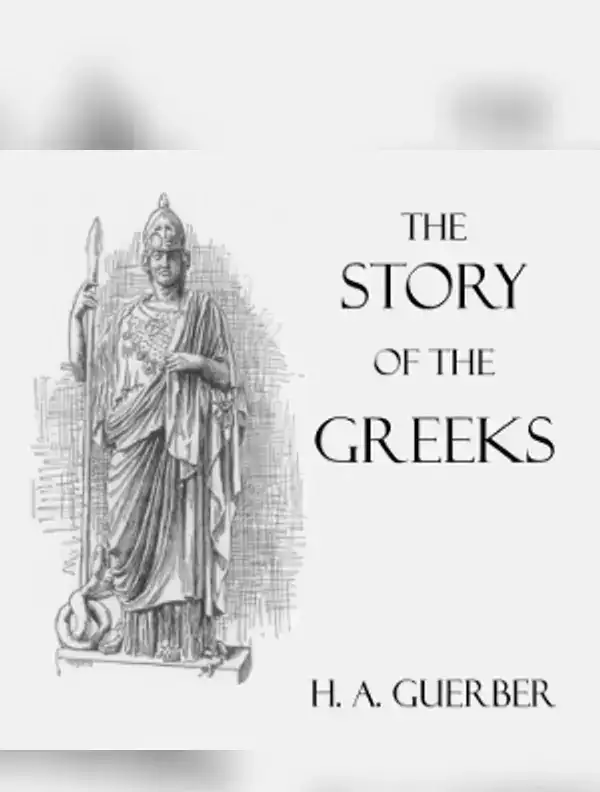
Long before modern academic textbooks reduced classical antiquity to dry dates and fragmented artifacts, Helene Adeline Guerber recognized that history endures best when communicated through the power of narrative. Her classic work bridges the gap between folklore and documented antiquity, offering a continuous chronicle of the ancient Greek world.
The Story of the Greeks by H. A. Guerber is a classic narrative history that weaves Greek mythology and historical biography into an accessible, chronological overview. Spanning 116 concise vignettes from the legendary flood of Deucalion to the fall of Corinth in 146 BC, the text illustrates how mythic ideals shaped classical Athenian democracy, Spartan militarism, and Alexander the Great’s imperial expansion. Best for: Young readers, classical education students, and history enthusiasts seeking an engaging, story-driven entry point into ancient Greece. Skip if: You require modern archaeological data or rigorous contemporary historiography.
| Author | H. A. (Helene Adeline) Guerber |
|---|---|
| Original Publication Era | Late 19th Century (1896) |
| Genre | Narrative History / Classical Mythology |
| Main Themes | Heroism, Civic Virtue, Conflict of City-States, Myth vs. Historical Fact, Imperial Rise and Fall |
| Target Audience | Middle-grade students, young adults, classical educators, and history novices |
| Narrative POV | Third-Person Omniscient / Episodic Biographical Narrative |
Plot Overview & Premise
Guerber structures her history as a progressive timeline that traces the evolution of Greek civilization across three major eras: the Mythic Age, the Classical Era, and the Hellenistic Period.
The text opens in the realm of legend, where mythic tales explain early Greek origin stories. Readers encounter foundational myths such as the Deluge of Ogyges and Deucalion, early city founders, and the tragic exploits of Daedalus, Icarus, and Jason’s Argonauts. Guerber pays extensive attention to legendary sagas, detailing Theseus and the Minotaur, the curse of Oedipus in Thebes, and the epic saga of the Trojan War—from the childhood of Paris to the wrath of Achilles and the fall of Ilium.
As myth transitions into recorded history, the focus shifts to the distinct socio-political development of the Greek city-states. Guerber contrasts the rise of Sparta—defined by the strict military code of Lycurgus, brutal physical training, and patriotic self-sacrifice—against the legislative evolution of Athens. The narrative tracks Athenian reform through the harsh codes of Draco, the balanced constitution of Solon, and the shifting fortunes of early leaders like Pisistratus.
The centerpiece of the historical narrative covers the high drama of the Greco-Persian Wars. Epochal events are rendered through vivid personal stories: the defense at Marathon, Leonidas and his three hundred Spartans at Thermopylae, and the naval triumph at Salamis. Following Persia’s defeat, the book charts the Golden Age of Athens under Pericles, the intellectual trial of Socrates, and the devastating civil strife of the Peloponnesian War. The final chapters track the geopolitical shift northward to Macedonia, detailing Philip II’s conquests, Alexander the Great’s campaign across Asia, the fragmentation of his empire, and the ultimate subjugation of Greece by Rome.
Key Themes & Literary Analysis
- Mythology as Cultural Foundation: Guerber treats early myths not merely as children’s fables, but as the essential cultural framework through which classical Greeks understood morality, divine justice, and civic obligation.
- The Ideological Rift (Sparta vs. Athens): A recurring analytical theme is the contrast between Spartan martial discipline and Athenian intellectual and political democracy. Guerber illustrates how these opposing values brought both strength during foreign invasions and ruin during internal conflict.
- Biographical History: Rather than focusing solely on economic or structural factors, the text presents history through biographical portraits. Figures like Aristides the Just, Epaminondas, Demosthenes, and Alcibiades embody specific moral virtues or personal flaws that directly alter the fate of their nation.
Who Should Read This?
Recommended For:
- Homeschoolers and classical educators looking for an engaging historical narrative for students.
- Readers wanting a clear, chronological overview of Greek history without heavy academic jargon.
- Fans of mythology who want to see how legendary stories connect directly to real historical figures.
Not Recommended For:
- Academic researchers looking for primary source critical analysis or modern archaeological findings.
- Readers who dislike Victorian-era moralizing or simplified historical interpretations.
Frequently Asked Questions
Does this book cover mythology or real history?
It covers both. Guerber intentionally starts with famous Greek myths—such as Theseus, the Labryinth, and the Trojan War—to reflect how the Greeks understood their own origins, before transitioning into historical records beginning around the early Olympic Games and the rise of Sparta.
Is this work suitable for young readers?
Yes. The book was originally written for young students and uses short, episodic chapters that emphasize heroic storytelling, making complex historical timelines easy to follow.
Where does the historical coverage end?
The narrative extends from early Greek myth through the classical era, the conquests of Alexander the Great, and concludes with the Roman conquest of Greece and the dissolution of the Achaean League in 146 BC.