
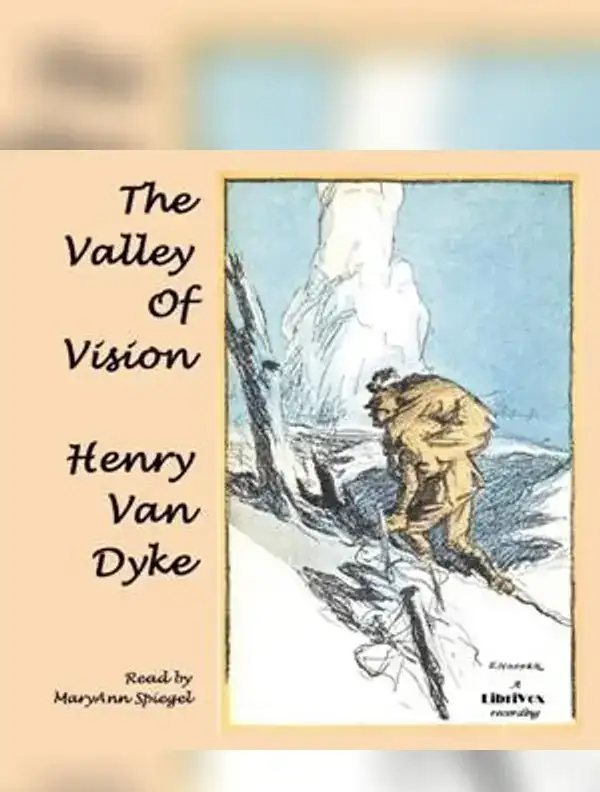
True perception often requires stepping into the shadows of human trial rather than observing the world from a comfortable distance. Henry van Dyke’s 1919 collection The Valley of Vision confronts the harrowing realities of the First World War to demonstrate how profound moral clarity emerges not from lofty vantage points of power, but through endurance, sacrifice, and shared grief.
The Valley of Vision by Henry van Dyke is a compelling short story and sketch collection set against the backdrop of World War I. Blending allegorical parables, wartime vignettes, and reflective dreamscapes, the book contrasts imperial aggression with spiritual resilience across tales like “The Antwerp Road” and “The Broken Soldier and the Maid of France.” This work is best suited for readers of classic early 20th-century literature, military history enthusiasts, and scholars of post-war philosophy. Those looking for fast-paced modern thrillers or neutral historical accounts may want to skip it due to its reflective tone and distinct Allied perspective.
| Author | Henry van Dyke |
|---|---|
| Original Publication Era | 1919 (Post-World War I) |
| Genre / Sub-genre | Short Story Collection / WWI Literature / Philosophical Parables |
| Main Themes | Insight through suffering, resistance to authoritarianism, moral courage, faith in human kindness |
| Target Audience | Readers interested in WWI history, Christian humanism, classic parables, and early 20th-century prose |
| Narrative POV | Varied (First-person observational and Third-person omniscient) |
Plot Overview & Premise
Written shortly after the conclusion of World War I, The Valley of Vision presents a series of fourteen interconnected sketches, dreams, and short stories bound together by a unified thesis: while the “mountain-top” offers a broad geographic view, it is inside the “valley” of hardship that humanity gains its deepest moral and spiritual sight.
Drawing on van Dyke’s real-world observations during the global conflict, the collection takes readers across multiple settings. Stories such as The Antwerp Road capture the immediate tragic fallout of war and human displacement in devastated European towns. In The Broken Soldier and the Maid of France, a battle-weary combatant encounters the enduring spirit of Joan of Arc, illustrating how faith revives collapsed spirits. Other entries, including Sketches of Quebec and A Sanctuary of Trees, shift focus toward serene natural landscapes and quiet reflection, offering respite from wartime devastation before returning to parabolic dreams like The Boy of Nazareth Dreams.
Key Themes & Literary Analysis
The defining thematic anchor of the work is the explicit contrast between mountain-top illusions and valley-born truths. Van Dyke directly addresses the contemporary geopolitical crisis of his day, interpreting the defeat of imperial expansion as a triumph of ethical strength over ruthless ambition. In his eyes, the high peaks represent the deceptive lure of global domination, whereas the low valleys represent the trial grounds where justice, human kindness, and spiritual character are forged.
Van Dyke’s prose utilizes elements of fable, classic rhetoric, and Christian humanism. Rather than focusing strictly on military tactics or geopolitical maneuvers, the author centers human empathy and quiet courage. The stories operate as allegories where ordinary citizens, wounded soldiers, and dreamers confront immense loss yet emerge with refined convictions. His inclusion of “Half-Told Tales” leaves space for the reader’s own moral contemplation, refusing to wrap every conflict in easy solutions.
Who Should Read This?
Recommended For:
- Historical Fiction & WWI Enthusiasts: Readers seeking authentic contemporary perspectives written immediately following the Armistice of 1918.
- Fans of Classic Allegory: Readers who appreciate short, reflective tales with strong ethical and spiritual undercurrents.
- Literary Scholars: Researchers analyzing how American authors processed the trauma and triumph of the Great War.
Skip If:
- You prefer gritty, realistic modern war fiction without moralizing or spiritual themes.
- You are looking for a singular, continuous novel-length narrative rather than an episodic anthology of vignettes and dreams.
Frequently Asked Questions
Is The Valley of Vision a unified novel or a collection of stories?
It is a curated anthology consisting of short stories, allegorical dreams, travel sketches, and philosophical parables. While each entry stands on its own, they are all linked by van Dyke’s overarching exploration of suffering, faith, and moral clarity during wartime.
What inspired Henry van Dyke to write this book?
The collection was directly inspired by van Dyke’s experiences and observations during World War I, including his time serving as the U.S. Minister to the Netherlands and Luxembourg. The book serves as his artistic and philosophical reaction to the war’s devastation and eventual resolution.
What does the title “The Valley of Vision” mean?
The title suggests that profound understanding of life, justice, and human value does not come from looking down from high places of pride or dominance. Instead, true vision is attained down in the “valleys” of sacrifice, grief, and shared human hardship.