
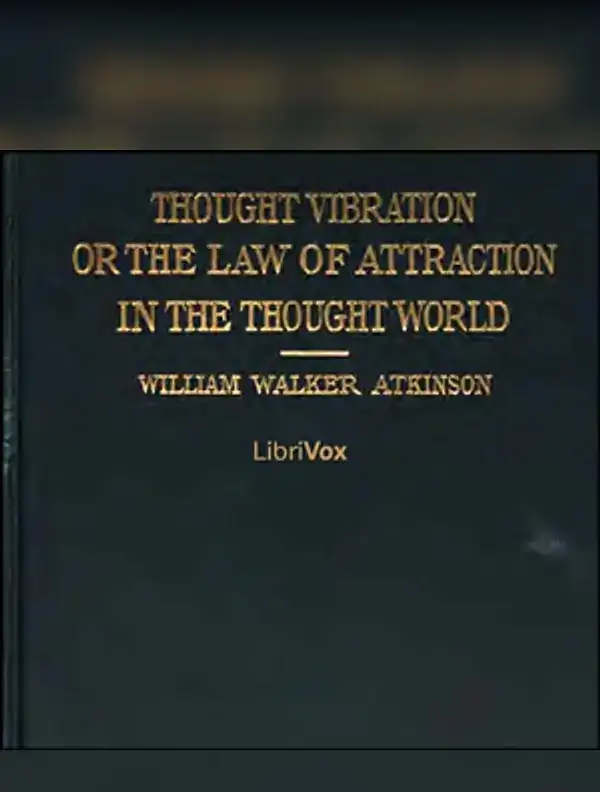
Long before contemporary self-improvement authors popularized manifestation, early twentieth-century thinkers were already mapping the invisible currents of human cognition. William Walker Atkinson’s foundational text investigates how mental energy functions like physical wave dynamics, drawing parallel experiences directly into an individual’s material life.
Thought Vibration, or The Law of Attraction in the Thought World by William Walker Atkinson is a landmark 1906 New Thought treatise exploring how internal mental states generate energetic frequencies that attract corresponding real-world circumstances. Ideal for readers seeking the historical origins of manifestation philosophy, mind-power techniques, and esoteric metaphysics, though skeptics requiring modern empirical neuroscience may find its Victorian-era scientific analogies speculative.
| Author | William Walker Atkinson |
|---|---|
| Original Publication Date | 1906 |
| Genre / Sub-genre | Non-Fiction / New Thought, Metaphysics, Historical Self-Help |
| Main Themes | Mental Frequency, Thought-Force, Law of Attraction, Cultivation of Willpower |
| Target Audience | Enthusiasts of early mind-power literature, historical self-help, and practical metaphysics |
| Tone / Writing Style | Instructional, Direct, Early 20th-Century Philosophical Prose |
Overview & Core Philosophy
Atkinson’s central argument hinges on a simple scientific parallel: just as light, heat, sound, and electricity propagate through space via distinct wave vibrations, human thoughts operate on exact physical and metaphysical laws of wave motion. Thought is presented not as an abstract, intangible ghost inside the brain, but as a refined form of dynamic energy capable of altering the thinker’s immediate environment and mental climate.
The work systematically details how individuals unwittingly attract conditions matching their dominant mental habits. Worry, fear, and resentment emit low, destructive frequencies that draw adverse events, while mental discipline, optimism, and concentrated courage radiate constructive forces. Rather than advocating passive wishful thinking, Atkinson insists on active mental hygiene—re-training the subconscious mind through repeated affirmation, focused concentration, and deliberate direction of the personal will.
Key Themes & Philosophical Analysis
- Thought as a Fine Material Force: Atkinson strips away supernatural mysticism, framing thought energy as a natural physical force governed by precise laws of attraction and resonance.
- The Antidote to Negative Mentality: The text emphasizes that fear and worry are misdirected thought-forces that paralyze action. Overcoming them requires replacing negative habits with positive mental imagery rather than fighting bad thoughts head-on.
- The Primacy of the Mental Will: Willpower acts as the directing engine. By exerting conscious control over mental focus, an individual transforms from an unwitting victim of external circumstance into an active architect of their destiny.
- Character Building via Auto-Suggestion: Long before modern cognitive behavioral tools emerged, Atkinson outlined methods for rewiring internal monologue to cultivate patience, courage, and business acumen.
Who Should Read This?
This text serves as an essential historical artifact for anyone researching the origins of modern self-help movements, the Law of Attraction, or early American metaphysics. Readers who appreciate direct, concise instruction free from modern marketing fluff will find immense value in Atkinson’s straightforward style.
Pros
- Offers direct, actionable mental discipline exercises without fluff.
- Provides deep historical context for modern manifestation theories.
- Clear, passionate, and accessible prose despite its 1906 publication date.
Cons
- Relies heavily on early 20th-century physics analogies that lack modern scientific validation.
- May feel repetitive in its core message across certain chapters.
Frequently Asked Questions
Is this book modern self-help or early esoteric philosophy?
It occupies the intersection of both. Published in 1906, it is a foundational pillar of the New Thought movement, which directly laid the groundwork for modern personal development and manifestation literature.
Did William Walker Atkinson write under other names?
Yes, Atkinson was an extraordinarily prolific writer who published over 100 books using numerous pseudonyms, including Yogi Ramacharaka, Swami Panchadasi, and Theron Q. Dumont, to separate his various spiritual and practical works.
How does this book differ from modern works like The Secret?
While modern manifestation books often focus heavily on material acquisition through visualization, Atkinson emphasizes internal character development, emotional self-mastery, and practical mental discipline alongside intentional focus.