
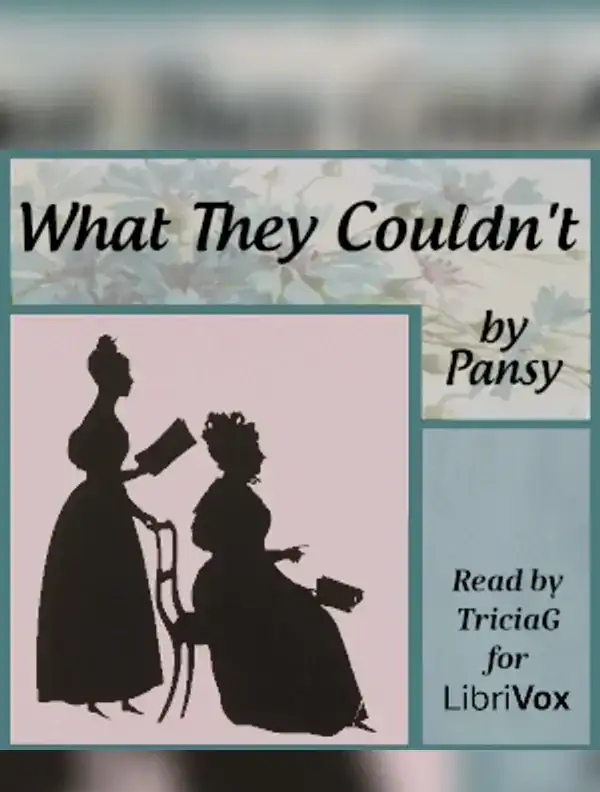
Maintaining a facade of wealth while drowning in debt is a uniquely crushing weight, a theme explored with startling clarity in 19th-century domestic fiction. Isabella Macdonald Alden, writing under her popular pen name Pansy, captures this precise psychological and moral strain in her classic home narrative.
In What They Couldn’t: A Home Story, Pansy crafts a compelling Christian domestic drama about the Cameron family as they exhaust their financial and emotional reserves trying to keep pace with high society. The central conflict erupts when their obsession with social status leads to severe financial distress for the father and leaves their youngest daughter unsupervised on a dangerous path toward moral compromise. This story is best suited for fans of Victorian domestic fiction, Gilded Age social critiques, and inspirational Christian literature, while readers who dislike explicit religious themes or traditional 19th-century pacing may want to look elsewhere.
| Attribute | Details |
|---|---|
| Author | Pansy (Isabella Macdonald Alden) |
| Original Publication Era | Late 19th Century (1893) |
| Genre | Domestic Fiction / Christian Moral Drama / Victorian Literature |
| Main Themes | Social Pretense vs. Financial Integrity, Parental Responsibility, Christian Grace, Moral Rehabilitation |
| Narrative POV | Third-Person Omniscient |
| Target Audience | Readers of classic 19th-century fiction, Christian historical literature, and domestic moral tales |
Plot Overview & Premise
The story centers on the Cameron household, a family trapped in the exhausting cycle of “making a dollar look to their friends as though it was ten dollars.” Driven by a desire to belong to elite social circles, the family stretches every resource to its absolute limit. This constant posturing forces the harried father into overwhelming financial anxiety and ethically questionable compromises, placing the household on the precipice of public humiliation and bankruptcy.
While the elder members of the family spend their energy curating an illusion of prosperity, domestic oversight falters completely. The youngest daughter, left largely to raise herself without proper spiritual or ethical guidance, drifts into risky social interactions and dangerous decisions. Her lack of boundaries leads her down a path of deceptive behavior, questionable financial transactions, and impending scandal.
As the narrative progresses through thirty tightly structured chapters, the web of borrowed money, social vanity, and hidden secrets begins to unravel. A series of personal crises—ranging from financial reckonings to deep spiritual awakenings—forces the Camerons to abandon their hollow pretenses. Through honest self-examination and faith in Jesus Christ, the family undergoes a painful process of reconstruction, eventually finding genuine peace and financial stability grounded in truth rather than illusion.
Key Themes & Literary Analysis
The Peril of Living for Appearances
Pansy offers a direct critique of the middle-class obsession with class mobility and artificial status. The narrative demonstrates how social vanity functions as a quiet corruption, forcing fundamentally decent people to lie, overspend, and neglect their most vital familial duties simply to satisfy the expectations of superficial acquaintances.
Parental Neglect and Unintended Consequences
A critical pillar of the novel is its exploration of domestic stewardship. Pansy highlights how parents who expend all their vital energy on social posturing inevitably neglect the moral and emotional nurture of their children. The youngest daughter’s slide toward moral peril serves as a direct warning about the consequences of absent or distracted parenting.
Redemption and Moral Reconstruction
In keeping with Pansy’s trademark evangelical storytelling, material success and social validation are shown to be hollow substitutes for moral character. True restoration occurs only when the characters face their failures honestly, abandon their false pride, and seek spiritual regeneration through Christian faith. The novel’s closing chapters emphasize that true home life requires honesty, humility, and faith.
Who Should Read This?
Recommended For:
- Historical Fiction Enthusiasts: Readers interested in late 19th-century American social customs, domestic life, and moral literature.
- Inspirational & Faith-Based Readers: Those looking for traditional Christian stories centered on redemption, repentance, and family values.
- Fans of Pansy (Isabella Macdonald Alden): Admirers of classic Sunday school literature and Victorian-era moral tales.
Not Recommended For:
- Readers who prefer modern, fast-paced plot structures with ambiguous morals.
- Those who are uncomfortable with explicit Christian theology and overt moral lessons in fiction.
Frequently Asked Questions
What is the core message of What They Couldn’t: A Home Story?
The core message is that attempting to maintain a false social standing through financial deception destroys family stability and moral character. True security and peace come from living within one’s means, practicing moral honesty, and establishing a home grounded in Christian faith.
Is this novel part of a larger series by Pansy?
While Pansy wrote dozens of interconnected and standalone books throughout the 19th century, What They Couldn’t functions as an independent, standalone domestic drama that can be fully enjoyed without prior reading of her other works.
Who was the author “Pansy”?
“Pansy” was the pen name of Isabella Macdonald Alden (1841–1930), a highly prolific American author, editor, and Christian communicator who wrote heavily for youth and families, leaving a lasting impact on 19th-century devotional literature.