
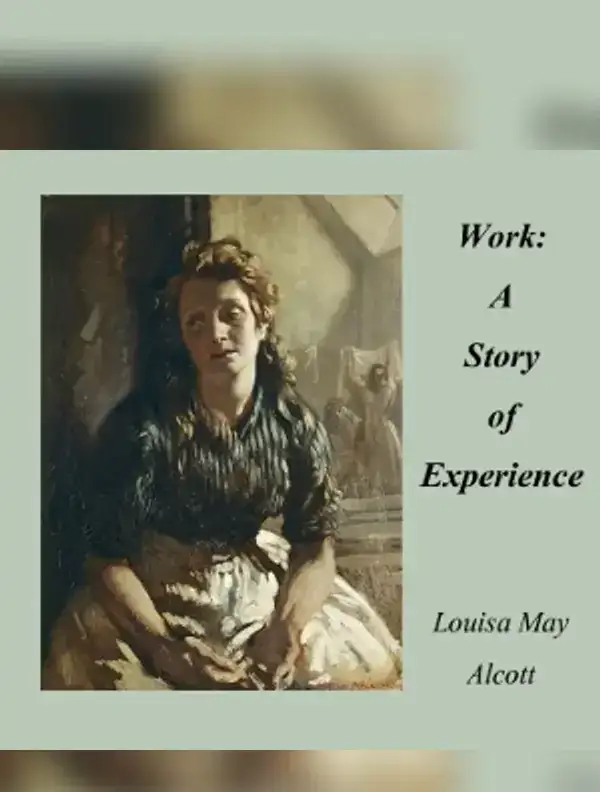
Louisa May Alcott’s semi-autobiographical novel strips away the romanticized gloss of Victorian womanhood to expose the grim, grinding reality of female wage labor in nineteenth-century America. Through a relentless exploration of economic survival, the narrative redefines independence not as a luxury reserved for the wealthy, but as an arduous moral imperative for women across all social strata.
Work: A Story of Experience by Louisa May Alcott is a 1873 social realist novel following twenty-one-year-old Christie Devon as she navigates six distinct occupations in search of financial autonomy and purpose. This book is ideal for readers interested in feminist history, Victorian literature, and early American labor reform, though readers seeking lighthearted romance or fast-paced plotting may find its moral philosophy dense.
| Metadata Field | Details |
|---|---|
| Author | Louisa May Alcott |
| First Published | 1873 |
| Genre | Social Realism / Feminist Fiction / Bildungsroman |
| Main Themes | Female Autonomy, Dignity of Labor, Social Reform, Sisterhood, Mental Health |
| Target Audience | Scholars of 19th-century literature, feminist history enthusiasts, fans of classic realist fiction |
| Narrative POV | Third-person limited |
Plot Overview & Premise
The narrative opens with Christie Devon declaring her independence from her uncle’s home, resolved to earn her own living in the city. Unwilling to accept a passive life of dependent domesticity, Christie enters the workforce, embarking on an episodic journey through various employment sectors available to nineteenth-century women.
Christie’s career spans six distinct roles, each highlighting different systemic hurdles:
- Domestic Servant: Experiencing the condescension and extreme hierarchy of wealthy households.
- Actress: Finding artistic outlet, but quickly confronting the superficiality and moral hazards of the theater.
- Governess: Facing class ambiguity, neither treated as family nor as an equal by her employers.
- Companion: Navigating psychological strain while caring for an invalid in a wealthy family.
- Seamstress: Enduring industrial exploitation, low wages, and physical fatigue in garment production.
As economic conditions worsen and exhaustion takes its toll, Christie sinks into isolation and suicidal despair, culminating in a pivotal moment near a river where she contemplates ending her life. Rescued by her friend Rachel and supported by the benevolent washerwoman Mrs. Wilkins alongside minister Thomas Power, Christie recovers her spiritual and mental footing.
Rebuilding her life, Christie finds employment at a botany greenhouse managed by David Sterling. Over time, mutual respect evolves into deep affection. When the American Civil War breaks out, David enlists in the Union Army, and Christie serves as a military nurse. Following David’s death on the battlefield, Christie relies on her inner strength to raise their daughter. Rather than retiring into passive grief, forty-year-old Christie channels her experience into public advocacy, acting as a bridge between affluent reformers and working-class women to champion labor rights and female solidarity.
Key Themes & Literary Analysis
The Redefinition of Women’s Labor
Alcott challenges the Victorian “Cult of True Womanhood,” which relegated women’s value strictly to the domestic sphere. By illustrating the physical labor, wage discrepancies, and vulnerability experienced by working women, Alcott argues that all honest labor carries intrinsic dignity. The text critiques an economic system that starves working women while denying them civic agency.
Transcendentalist Philosophy and Self-Reliance
Deeply influenced by Alcott’s real-life interactions with Ralph Waldo Emerson and Henry David Thoreau, the novel infuses Transcendentalist ideals into Christie’s journey. Spiritual growth does not occur through passive religious adherence, but through direct action, personal trial, and labor. Christie’s ultimate salvation comes from self-reliance coupled with active service to others.
Cross-Class Sisterhood and Collective Activism
A central message of the novel is that individual success is insufficient; true progress requires structural solidarity. Christie’s evolution from an isolated worker seeking individual survival into an activist uniting upper-class patronesses with disenfranchised factory workers emphasizes that female emancipation must be inclusive across socioeconomic lines.
Who Should Read This?
Recommended For:
- Readers seeking an unvarnished historical look at 19th-century working women.
- Fans of Louisa May Alcott looking for her more mature, politically charged adult fiction beyond Little Women.
- Students and scholars of labor history, feminist theory, and American social realism.
Who Might Want to Skip:
- Readers expecting a light Victorian romance; the narrative prioritizes economic reality over courtship.
- Those who dislike episodic structures or philosophical and sermon-like passages common to 19th-century reform literature.
Frequently Asked Questions
Is Work: A Story of Experience based on Louisa May Alcott’s real life?
Yes, the novel is heavily autobiographical. Before gaining financial stability with Little Women, Alcott worked as a seamstress, domestic servant, governess, and Civil War nurse, enduring many of the same economic hardships and emotional struggles depiction in Christie Devon’s journey.
How does this book differ from Little Women?
While Little Women focuses on domestic family life and moral growth within a supportive household, Work addresses explicit adult issues including economic survival, industrial exploitation, suicidal depression, class antagonism, and political activism.
What is the significance of the ending of the novel?
The ending rejects the traditional literary trope of solving a female protagonist’s problems through marriage. Instead, as a widow at age forty, Christie achieves fulfillment through community leadership, maternal duty, and organized advocacy for working-class women.